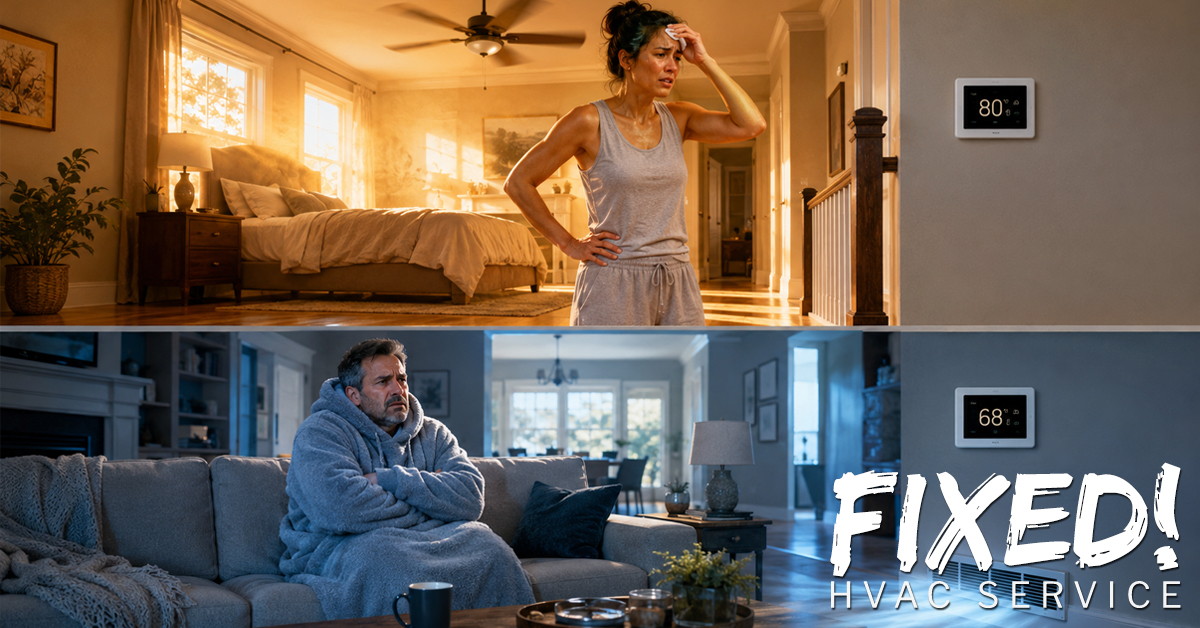
Hot upstairs rooms and cold downstairs spaces are common complaints in many Maryland homes. In Annapolis, this problem often appears during the spring and summer transitions. One floor feels stuffy, while another feels chilly. Meanwhile, your thermostat claims everything is fine.
That difference can feel frustrating. You adjust the thermostat, close vents, open doors, and hope for the best. However, uneven temperatures usually point to airflow, insulation, or equipment issues.
At FIXED! HVAC, we help homeowners solve comfort problems every season. Since 2013, our family-owned team has provided accurate, honest, value driven HVAC service.
Why Upstairs Rooms Get So Hot
Warm air naturally rises. Because of that, upper floors often collect heat before lower floors do. This creates the classic hot upstairs problem.
Sun exposure also matters. Roofs and attics absorb heat throughout the day. Then that heat radiates into bedrooms and hallways upstairs.
Additionally, upstairs rooms often sit farther from the HVAC equipment. Longer duct runs can reduce airflow before conditioned air reaches those spaces.
Why Downstairs Rooms Stay Cold
Lower floors often stay cooler because heat rises away from them. Basements and first floors also gain less direct sun exposure. As a result, downstairs areas may feel comfortable or even too cold.
Your thermostat location can make this issue worse. Many thermostats sit on the main floor. If that floor feels cool, the system may shut off too soon.
Consequently, upstairs rooms never receive enough cooling. The thermostat is satisfied, but your bedroom still feels uncomfortable.
Understanding Stack Effect
The stack effect describes how air moves vertically through your home. Warm air rises and escapes through upper levels. Cooler air enters lower areas to replace the warmer air.
During warmer months, the stack effect can increase heat upstairs. In winter, it may also create drafts downstairs. This movement becomes stronger in homes with air leaks.
Older Annapolis homes often experience the stack effect more noticeably. Gaps around attics, chimneys, doors, and framing allow air movement.
Poor Insulation
Insulation helps slow heat transfer. When attic insulation is thin or damaged, upstairs rooms heat up quickly. Poor insulation also allows conditioned air to escape faster.
Many Maryland homes have attics that get extremely hot in summer. Without proper insulation, that heat moves into living spaces. Bedrooms under the attic are often the first rooms to feel uncomfortable.
Adding insulation can improve comfort and reduce energy use. It also helps your HVAC system work less during extreme weather.
Duct Leaks
Leaky ducts waste conditioned air before it reaches your rooms. This problem often affects upstairs areas because ductwork runs through hot attics.
If cool air leaks into the attic, bedrooms receive weaker airflow. Meanwhile, your system keeps running, and energy costs increase.
Professional duct inspection can reveal hidden leaks. Sealing ductwork helps deliver more air where your home needs it.
Blocked Vents and Returns
Airflow needs a clear path. Furniture, rugs, curtains, and storage can block supply vents. Similarly, blocked return vents can starve your system of air.
Restricted airflow creates pressure problems throughout the house. Some rooms receive too much air, while others receive too little.
Walk through your home and check every vent. Make sure nothing blocks airflow. This simple step can quickly improve comfort.
Closed Bedroom Doors
Closed bedroom doors can create airflow problems. When supply air enters a closed room, it needs a way back to the return. Without that path, pressure builds.
That pressure can reduce circulation and create uneven temperatures. Upstairs bedrooms often suffer from this issue at night.
Leaving doors open can help. However, transfer grilles or return pathways may provide better long-term results.
Dirty Air Filters
A dirty filter restricts airflow through your entire HVAC system. When airflow drops, comfort problems become more noticeable. Upstairs rooms may feel warm because not enough air reaches them.
Replacing filters regularly supports better airflow and indoor air quality. During spring and summer, check filters monthly.
If you have pets or allergies, replace filters more often. Cleaner filters help your equipment run more efficiently.
Weak Blower Motors
Your blower motor pushes air through the duct system. If it weakens, airflow may drop throughout the home. Further rooms often feel the effects first.
A weak blower can also make your system run longer. Even then, it may never balance temperatures properly.
Technicians can test blower performance and motor condition. If needed, repairs can restore stronger airflow.
Improperly Sized HVAC Systems
System size matters greatly. An undersized unit may not cool the upstairs during hot weather. It runs constantly but still falls behind.
Conversely, an oversized system may cool the main floor too quickly. Then it shuts off before upstairs rooms improve.
Proper sizing requires a professional load calculation. This calculation considers square footage, insulation, windows, layout, and ductwork.
Zoning Systems
Zoning systems divide your home into separate comfort areas. Each zone uses its own thermostat and dampers. This allows better temperature control between floors.
For example, upstairs can call for more cooling without overcooling downstairs. That makes zoning helpful for homes with persistent hot upstairs issues.
Zoning works best when designed carefully. FIXED! HVAC can evaluate whether zoning fits your system and duct layout.
Mini Splits for Problem Rooms
Sometimes one room remains uncomfortable no matter what you try. A ductless mini-split can solve that problem directly.
Mini-splits provide targeted heating and cooling without ductwork. They work well for bonus rooms, sunrooms, additions, and upstairs bedrooms.
This option can be especially useful in older Annapolis homes. It improves comfort without requiring major duct renovations.
When to Add a Second System
Large homes may need more than one HVAC system. A single unit can struggle with multiple floors and long duct runs. Adding a second system can improve control and comfort.
Second systems often make sense for finished attics or large additions. They also help homes with major temperature differences between floors.
A professional evaluation can determine whether a second system is worthwhile. Sometimes duct repairs or zoning solve the issue instead.
Quick Steps Homeowners Can Try
Start with simple changes. Replace the air filter and open all vents. Next, keep bedroom doors open when possible.
Then check curtains and blinds upstairs. Blocking direct sunlight during the day can reduce heat gain.
Also, use ceiling fans correctly. Fans should spin counterclockwise in summer to create a cooling breeze.
When to Call FIXED! HVAC
Call FIXED! HVAC if simple steps do not solve the problem. Persistent uneven temperatures usually need professional diagnosis.
Our technicians check airflow, ductwork, thermostat placement, equipment size, and system performance. Then we explain the issue clearly.
You should also call if your system runs constantly. Rising energy bills, weak airflow, and noisy equipment also deserve attention.
Why Annapolis Homeowners Trust FIXED! HVAC
FIXED! HVAC is a small business rooted in Annapolis, Maryland. Since 2013, we have earned a reputation for quality work and fair pricing.
Our mission is to provide accurate, honest, value driven HVAC services. We serve residential and light commercial customers with care.
As a local, family owned business, we avoid large regional overhead. That helps us provide practical solutions without pressure.
Customers can read our reviews on Google, Yelp, Facebook, and Angie’s List. Those reviews show our commitment to doing the job right.
Get Comfortable on Every Floor
Hot Upstairs rooms do not have to be part of summer living. With the right approach, your home can feel balanced and comfortable again.
FIXED! HVAC can help with airflow diagnostics, duct repairs, AC maintenance, heat pump service, thermostat upgrades, mini-splits, zoning, filters, humidifiers, air purification, and replacement guidance.
Contact FIXED! HVAC today. We will help your Annapolis home stay comfortable upstairs, downstairs, and everywhere in between.